Why Heavy Cutting on Iron Molds Is Slow? Exploring the Dynamic Rigidity Advantage of Bridge-Column Machining Centers
12 12,2025
Application Tips
Struggling with low efficiency and poor precision in iron mold machining? The issue may lie in your machine's structure. This article delves into the dynamic rigidity benefits of moving bridge-column CNC milling machines, contrasting them with traditional vertical and gantry designs. It explains how a fixed beam + table configuration reduces vibration transmission, enhancing stability during heavy cutting—validated by real-world results from large cast iron part milling: up to 3 more workpieces per hour and surface roughness reduced by 0.5μm (DC1113 model). Practical maintenance tips for guide lubrication, thermal balance control, and calibration ensure long-term performance. Ideal for mold manufacturers seeking reliable, high-efficiency production lines.
Why Is Your Iron Mold Machining So Slow? The Dynamic Stiffness Advantage of Bridge-Column CNC Milling Machines
In iron mold manufacturing, low efficiency and inconsistent surface finish aren’t just inconveniences—they’re bottlenecks that cost time, money, and customer trust. If your current setup struggles with vibration during heavy cutting or can't maintain precision across multiple parts, the issue may lie in your machine’s structural design—not your operator.
The Hidden Problem: Vibration Transfer in Traditional Structures
Most conventional vertical milling machines and even some gantry types suffer from poor dynamic stiffness—especially when processing large cast iron molds. Why? Because their moving components (like the spindle head) are mounted on a structure that flexes under load. This creates a feedback loop: more force → more deflection → higher vibration → lower accuracy.
Engineer Tip: Think of it like a tall building in an earthquake—it doesn’t matter how strong the foundation is if the upper floors sway too much. That’s exactly what happens in standard setups when you push for high material removal rates.
How Bridge-Column Design Changes Everything
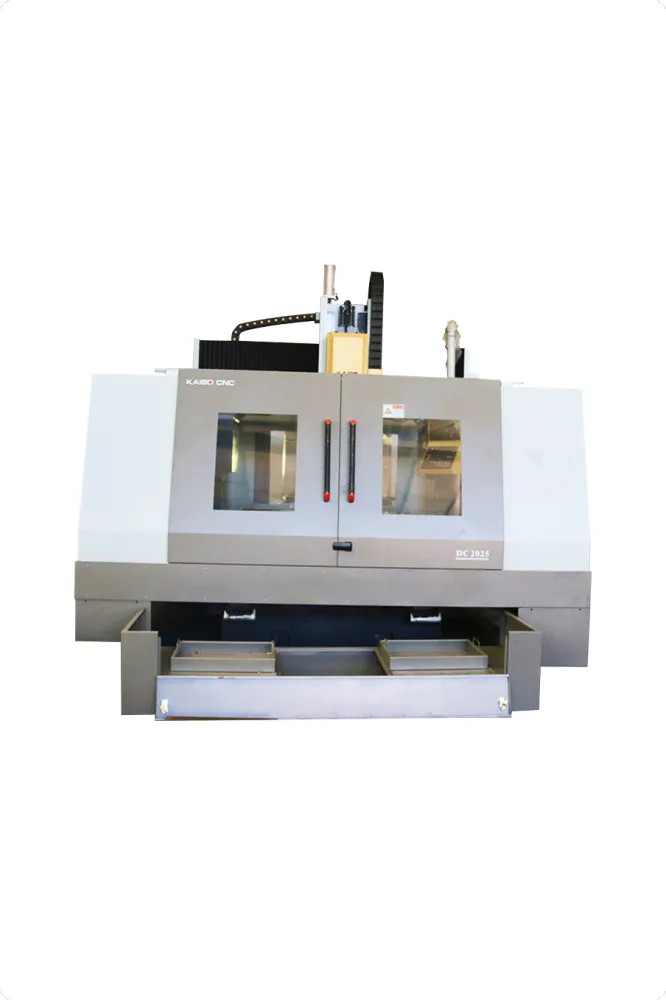
Enter the mobile bridge-column CNC mill—a design inspired by civil engineering principles. With a fixed crossbeam and a stationary worktable, this architecture minimizes motion-induced vibrations. The entire system acts like a rigid frame, distributing cutting forces evenly across the base structure instead of letting them concentrate at the spindle.
Real-world test data from a Chinese mold shop using the DC1113 model shows:
- Up to 30% faster cycle times per batch (from 4 hours to 2.8 hours for 12 pieces)
- Surface roughness improved by 0.5 μm (Ra from 3.2 μm to 2.7 μm)
- Consistent dimensional accuracy within ±0.02 mm over 8-hour runs
When You Need Precision—and Speed—Together
This isn’t just theoretical. In applications like machining complex mold inserts or large die-cast patterns, the DC1113 delivers real operational benefits:
- No need for secondary finishing passes due to consistent surface quality
- Reduced tool wear—less downtime for tool changes
- Higher throughput without sacrificing part integrity
Maintenance Tips That Keep Performance Consistent
Even the best machine needs care. To ensure long-term stability:
- Weekly lubrication of linear guides (use ISO VG 32 oil)
- Monthly thermal equilibrium checks—allow 30 minutes warm-up before critical operations
- Quarterly calibration of axis positioning using laser interferometer
Choose DC1113 — because reliable machining shouldn’t be a gamble.
Built for durability, engineered for precision.
See How DC1113 Can Boost Your Mold Production Now




 <#else>





