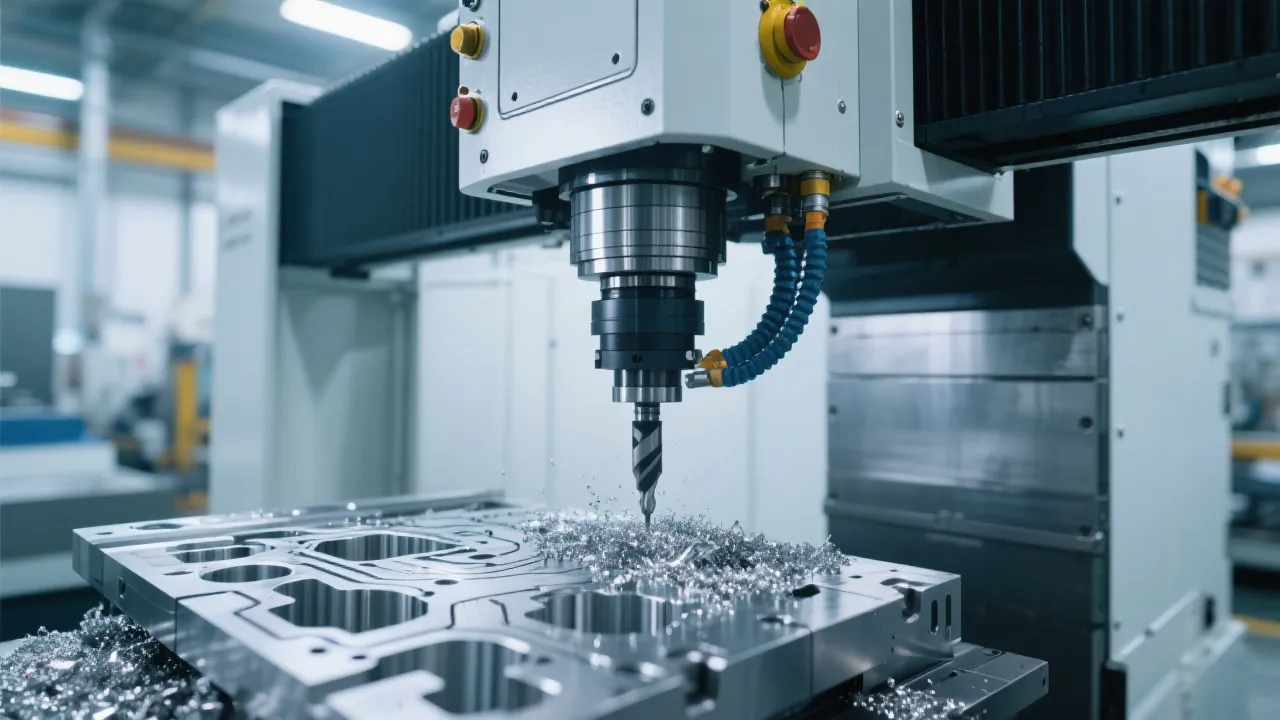
In the dynamic landscape of iron mold manufacturing, the technology of multi-axis rotary tables in CNC milling machines has emerged as a game-changer. This article delves deep into the development trends and application prospects of 4/5-axis rotary table technology in the field of iron mold processing.
Iron mold manufacturing involves several key processes, such as bevel milling, deep cavity grooving, and special-shaped hole machining. Bevel milling requires precise control of the milling angle to ensure the accuracy of the iron mold surface. For example, in a typical iron mold production line, bevel milling accounts for about 30% of the total processing time. Deep cavity grooving, on the other hand, demands high stability of the milling machine to avoid tool breakage and ensure the smoothness of the cavity surface. Special-shaped hole machining is often the most challenging part, as it requires complex programming and precise tool path planning.
One of the main technical difficulties in iron mold processing is the programming logic of the rotary axis. The programming of 4/5-axis rotary tables is more complex than that of traditional 3-axis machines. Engineers need to have a deep understanding of the geometric relationship between the workpiece and the tool to write efficient and accurate programs. Another challenge is the optimization of tool paths. By optimizing the tool path, the number of clamping times can be effectively reduced, which not only improves processing efficiency but also reduces the risk of errors and interference. For instance, through tool path optimization, the processing time of some iron molds can be reduced by up to 20%.
Let's take a look at the programming logic of the rotary axis. The following is a simple example code for 4-axis rotary table programming:
  N10 G90 G54 X0 Y0 Z0
  N20 M03 S1000
  N30 G00 X10 Y20
  N40 A90 ; Rotate the A axis to 90 degrees
  N50 G01 Z-10 F100
  ...
This code shows the basic steps of moving the tool to a specific position and rotating the A axis. In terms of tool path optimization, engineers can use advanced CAM software to simulate the machining process and find the best tool path. By analyzing the actual machining case, we can see that through reasonable programming and tool path optimization, the processing accuracy can be improved by about 15%.
Ningbo Kaibo CNC Machinery Co., Ltd.'s DC1113 medium-sized double-column CNC milling machine stands out in the market. It is equipped with advanced 4/5-axis rotary table technology, which can effectively meet the various needs of iron mold processing. The machine features high precision, high stability, and excellent performance. With its advanced control system, it can accurately execute complex machining programs, reducing the risk of errors and interference. Moreover, the company provides excellent after-sales service, ensuring that customers can get timely technical support and maintenance services.
We understand that you may have some questions about the technology and products. Here, we have prepared an interactive Q&A session. If you have any questions about 4/5-axis rotary table technology, iron mold processing, or our DC1113 medium-sized double-column CNC milling machine, please feel free to leave your questions in the comments section below. Our experts will answer them as soon as possible.
Don't miss the opportunity to enhance your iron mold processing capabilities. Choose Ningbo Kaibo CNC Machinery Co., Ltd.'s high-quality and reliable CNC milling machines to improve your processing competitiveness. Click here to learn more about our products!




 <#else>